Categories
Blog

Using the past to help us to understand the future of the Palace of Westminster

Ahead of next Tuesday’s Virtual IHR Parliaments, Politics and People seminar, we hear from Dr Alexandra Meakinof the University of Leeds. On 9 November 2021, between 5.15 p.m. and 6.30 p.m., she will be responding to your questions about her pre-circulated paper on ‘Using the past to help us understand the future of the Palace of Westminster’.

The Palace of Westminster is in a state of advanced disrepair, and faces what was described by a Joint Committee of MPs and Peers in 2016 as ‘an impending crisis which we cannot reasonably ignore’. While a major refurbishment project—Restoration and Renewal (R&R)—was approved in 2018, the future of the Palace remains uncertain, as concerns mount among some MPs about the cost and the prospect of temporarily moving out to allow the work to take place.

The risk of a catastrophic fire, flood or failure of the essential services within the Palace has developed over many decades, as vital maintenance was neglected and the infrastructure serving the building went far past its expected lifespan. Indeed, some of the mechanical and electrical plant dates back to the building’s establishment in the mid-19th century, as a replacement for the old Palace, destroyed by fire in 1834.

The 1834 fire, as discussed previously on this blog, occurred after multiple unheeded warnings about the state of the building, a situation worryingly similar to today. It is not the only lesson from history, however, which may be relevant for current discussions. This blog posits that through historical analysis we can identify five recurrent themes that help to explain policymaking decisions relating to the Palace as a legislative building (figure 1, below).
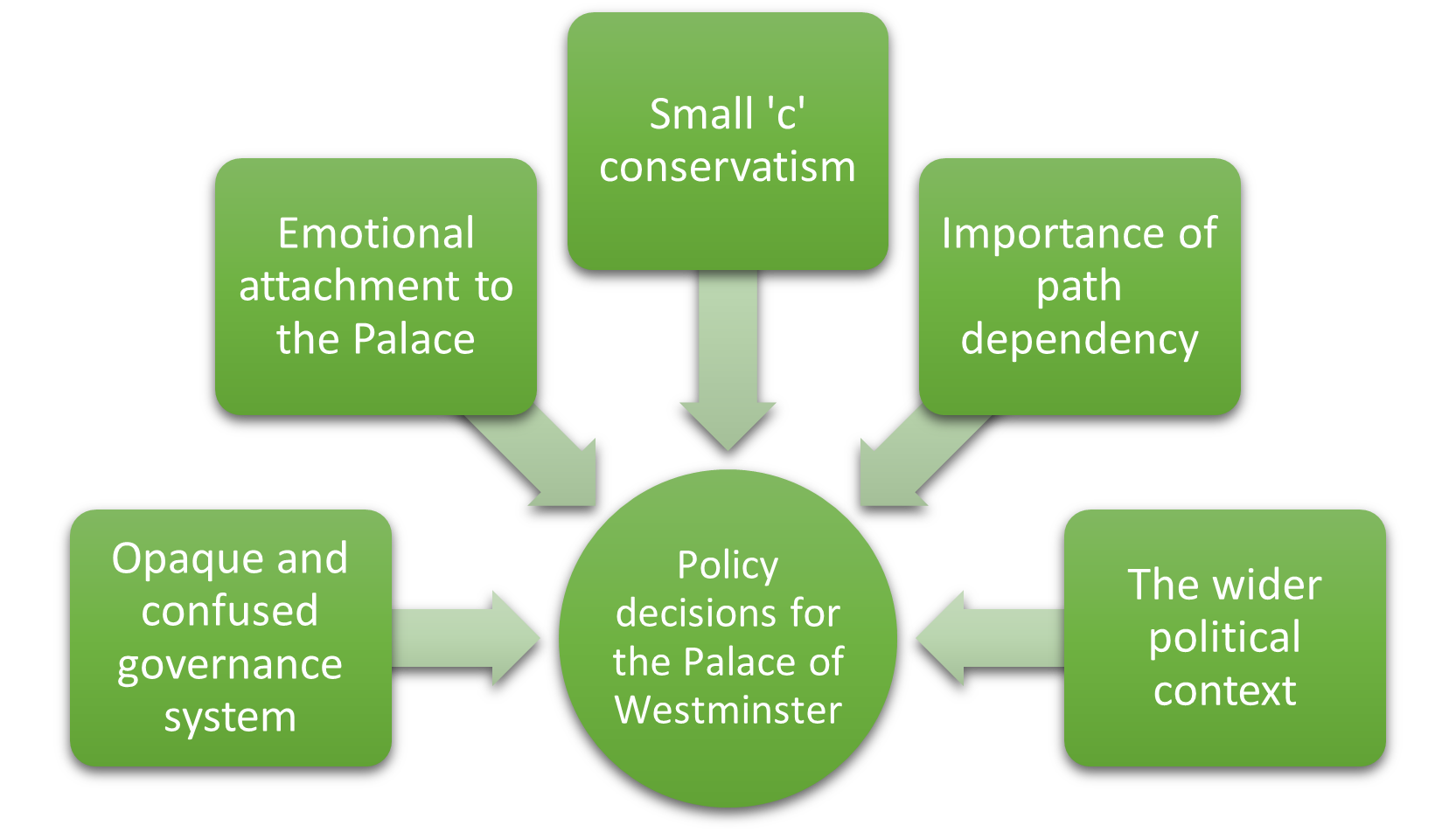
Figure 1: Explaining policy decisions

A confused governance system has been evident in Westminster for centuries, manifested through divided patronage between the King and Prime Minister in the appointment of architects to work on the Palace in the 18th century and delays to the rebuilding after the 1834 fire caused by contradictory instructions from ministers, MPs and Peers—an issue still present today. In addition, the emotional attachment parliamentarians feel about their workplace—for example in the form of a connection to their predecessors, transmitted through the very fabric of the Palace—influences the decisions they make about its future.

This is linked to the third recurrent theme: a clear unwillingness to make radical changes to the Palace. When disaster has occurred, there has been a tendency to recreate the past: either in the exact replica of the previous Commons chamber in the 1940s (described by one MP in 1945 as taking ‘nostalgia to the stage of absurdity’), or in Barry’s design for the new Palace after the 1834 fire. These decisions then become precedent to be followed faithfully in future, a form of path dependency that explains the reluctance to move out of the Palace, the fourth theme. Finally, historical analysis shows that you cannot explain decisions about the Palace of Westminster purely by considering what was happening within the building. The intrinsically political nature of the legislature means that wider political events have influenced the policies chosen for the building.

The Elizabeth Tower covered in scaffolding, 2019; image: Ethan Doyle White, CC via Wikimedia Commons

Looking to history helps to explain how R&R became necessary but it can also explain why its future remains unclear. While the Parliamentary Buildings (Restoration and Renewal) Act 2019 legislated for an independent governance structure, the future of the R&R project continues to be subject to the views of the House of Commons Commission. A number of MPs remain opposed to leaving the Palace of Westminster even temporarily, demonstrating the same attachment to the building as has been witnessed for generations. There have been repeated efforts to scale back the scope of programme, in a further sign of the tendencies towards conservatism and to reflect the economic impact of the coronavirus pandemic. A key lesson from the historical analysis is that major work to the Palace of Westminster has tended to occur only when unavoidable: despite the approval of R&R, it may be that history repeats itself and the ‘impending crisis’ warned of in 2016 occurs.

The threat of a crisis is one major reason why the future of the Palace of Westminster matters. The risk to the Palace is not just about the potential loss of an emblem of national identity, but also the very real dangers faced by the people working in or visiting Parliament. Former Leader of the Commons, Andrea Leadsom, has warned that ‘it is only by sheer luck that no one has been injured or killed’ to date. But the future of the building also matters for the health of our democracy. Legislative buildings are not just symbols of the institution, but their architecture, design and décor affect how people—parliamentarians, staff and visitors—behave within. Through the necessary work to fix the pipes and stonework, the UK Parliament has an opportunity to think about how it can build a legislative building fit for the 21st century, shaped by the public and designed to facilitate their engagement with democracy. Taking this opportunity before crisis occurs would demonstrate that MPs and Peers really have learnt from the past.

To find out more, Alexandra’s full-length paper ‘Using the past to help us understand the future of the Palace of Westminster’ is available here.

This blog was originally posted on The History of Parliament Website and is reposted with permission.

Categories
Blog

Parliaments are watching to make sure climate legislation has an impact

How have parliaments responded to the Paris Agreement during the past five years? In which way are parliaments making sure that climate legislation does have an impact? These were some of the questions guiding the new report “Parliaments and the Paris Agreement”, published by Westminster Foundation for Democracy, ParlAmericas, INTER PARES, and GLOBE International. Based on this report, we put forward five golden rules for conducting climate-proof Post-Legislative Scrutiny.

By Rafael Jimenez Aybar and Franklin De Vrieze.

With only a few of weeks until the start of COP-26 in Glasgow, the role of parliaments in advancing international climate commitments deserves a spotlight. Parliament’s critical role in the development, implementation, and monitoring of their country’s climate objectives is often underestimated. 

The recent report Parliaments and the Paris Agreement” shows that, to date, action on climate by parliaments has gone beyond adopting climate policies and legislation. The report also notes how parliaments focus on implementation and impactthus contributing to promoting environmental democracy by upholding the environmental rule of law. 

While legislation is of critical importance to achieve national climate commitments, it is equally vital to ensure that the legislation is implemented and has the intended outcomes. This process is often referred to as Post-legislative Scrutiny (PLS) or ex-post impact assessment of legislation. 

PLS can help identify implementation shortcomings, areas of improvement and good practices. While PLS can provide oversight of the implementation gap, the gap between ambitions legislated for and those delivered, PLS can also provide a window for increasing legislative ambitions in line with what the science demands. 

PLS can be applied to climate-specific legislation as well as to general legislation which is not specifically environment- or climate-focused. In case of the latter, one speaks of a climate and environmental “lens” over PLS

Based on the new report, we outline five golden rules for conducting climate-proof PLS. The five golden rules capture the do’s and don’ts for parliaments willing to engage on PLS of environment and climate legislation and PLS of general legislation with an environment and climate lens.

1. Make the work of parliament climate-proof. Climate-proof PLS is not the job of the Environmental Committee only. All committees need to be engaged. This means that parliaments need to organise their internal processes to ensure that environmental oversight spans the entirety of its work, including through inter-committee communication and environmental and climate mainstreaming in committees’ work. This requires that all MPs and staff have been informed of the national targets related to mitigation of greenhouse gas emissions and the strategy on adaptation.

For instance, the Scottish Parliament applies its sustainable development Impact Assessment Tool to all its legislation. It helps parliamentarians moving beyond simply asking ‘what is the economic cost or benefit of this law’ to asking, ‘what is the carbon cost?’. The UK Parliament Environmental Audit Committee has a cross-government mandate to consider the extent to which government departments and public bodies contribute to environmental protection and sustainable development.

2. Make all PLS inquiries climate-inclusive. For PLS of general legislation, it is important that environmental impact is explicitly included in the PLS guidance, calls for evidence, and questions used in data collection. The PLS report needs to include a section on findings and recommendations relevant to the environment and climate; going beyond findings and recommendations related to the thematic remit of that law. This is similar to the approach that says that any legislative impact report must have a section relevant to gender equality.

An example is the Indonesian Parliament which has started PLS of the ‘Law on Job Creation’ with specific attention to the risks of driving environmental degradation.

3. Employ environmental treaties as entry-point for environmental PLS. Parliaments have a key role in ratifying international environmental and climate treaties. PLS can provide a window of analysis to check on the government’s commitments and adherence to such treaties as reflected in the national law. Furthermore, delivery against international treaties takes place at national, regional, and sub-regional level. Parliaments are critical to ensure that this happens.

4. Look at the role of implementing agencies of legislation. Each law designates an institution, department or ministry for its implementation. In many countries, the piecemeal development of environmental legislation risks regulatory overlap. Through PLS, MPs can review the role of implementing agencies of environmental laws, in order to consider whether compliance and enforcement regimes exist, and what is their effectiveness, legality, and coherence.

For example, the National Assembly of Nigeria is currently assessing the Environmental Impact Assessment Act and the Act on the National Agency for the Great Green Wall.

5. Review the legislative targetsIt is important that legislative targets for climate and environment are adequate, timely and achievable. Setting targets alone does not in itself improve environmental outcomes. PLS of climate and environment legislation should therefore focus its assessment not only on targets, but also performance against those targets – asking if the targets and actions to meet them are doing enough.

For example, the Canadian Parliament enacted a review clause in the Net-Zero Emissions Accountability Act to ensure a parliamentary review after 5 years of it coming into force with the aim to sharpen the targets.

Rafael Jimenez Aybar is Environmental Democracy Adviser and Franklin De Vrieze is Senior Governance Adviser at Westminster Foundation for Democracy (WFD).

Categories
Blog

How did parliamentary procedure change while Theresa May was Prime Minister?

Thomas Fleming of Nuffield College discusses his recent research into parliamentary procedural change during the premiership of Theresa May.

Parliamentary procedures have many important political consequences. Yet during the premiership of Theresa May, British parliamentary procedure was scrutinised, criticised, and challenged to an extent unprecedented in recent years. This placed intense pressures on the important ‘rules of the game’ governing parliamentary politics in Britain. In a recent article in Parliamentary Affairs, I have described these pressures and their consequences.

How was parliamentary procedure challenged?

This period saw four areas of parliamentary procedure come under particularly intense scrutiny and pressure.

First, the government’s control of the agenda – a key feature of parliamentary politics at Westminster – was challenged by several controversial rulings by the then Speaker, John Bercow. Bercow initially broke with convention by allowing a vote on a backbench amendment to the government’s timetable for the ‘meaningful vote’ on their Brexit deal. After that deal had been defeated in the Commons twice, Bercow angered the government further by ruling that they couldn’t bring it back for a third vote unless it were a substantially different proposition.

Second, the government’s agenda control was also challenged by backbench MPs who opposed the government’s approach to Brexit. On several occasions backbenchers voted to set aside the parliamentary rule granting the government near-total control of the Commons agenda (Standing Order 14), and set the agenda themselves. This highly controversial move gave backbenchers the opportunity to hold ‘indicative votes’ on various alternative Brexit approaches, and to rapidly pass legislation in April 2019 which aimed at preventing (or at least delaying) a ‘no deal’ Brexit.

Third, this period saw intense controversy around the procedures by which MPs cast their votes in parliament. Historically, MPs have only been able to vote if they are physically present. Between 2016 and 2019 there was ongoing discussion of the adverse effects of this rule for MPs who are new parents. Despite a growing consensus around Professor Sarah Childs’ proposal that new parent MPs be entitled to vote by proxy, the government was slow to actually implement any reforms. In the end, this change was only implemented after high-profile controversies involving the MPs Jo Swinson and Tulip Siddiq highlighted the need for urgent change.

Finally, this period saw considerable scrutiny of the process by which backbench MPs propose legislation known as ‘private members’ bills’.  This process has long been criticised as opaque and open to obstruction. But its shortcomings received widespread public attention when a Conservative MP, Christopher Chope, blocked bills which aimed to ban ‘upskirting’ and increase the protection of children from female genital mutilation. Much criticism in the press and from fellow Conservatives was focused on Chope himself. But this incident also appeared to validate existing concerns about parliament’s rules, and the ease with which individual MPs are able to block their backbench colleagues’ legislative proposals.

How did parliamentary procedure change?

Given how many parliamentary debates and newspaper column inches were occupied by these discussions, they led to surprisingly little formal change in how the House of Commons works.

Of the four areas of pressure discussed above, only one – proxy voting – saw any change in the Commons’ formal rules. In January 2019, the Commons adopted a system allowing new parent MPs to nominate another MP as a proxy to vote on their behalf. This system was only established on a temporary basis, but looks set to become permanent. When it was initially due to expire in January 2020, the scheme was extended without any opposition. Moreover, it has subsequently been widened to grant proxy votes to MPs who are unable to attend Westminster in person due to the coronavirus pandemic.

However, the three other areas of pressure on parliamentary procedure described here saw no changes in the Commons’ formal rules. In fact, this period saw remarkably little formal parliamentary reform. Using data from the ParlRulesData Project, I have calculated how far the House of Commons’ formal rules were altered during the tenure of every prime minister since 1945. This shows that only three post-war prime ministers – Anthony Eden (1955-57), Alec Douglas-Home (1963-64), and James Callaghan (1976-79) – oversaw less extensive changes than Theresa May.

 While this period saw very little formal change to parliament’s rules, it did nonetheless see significant informal change. When backbenchers voted to suspend Standing Order 14 and take control of the Commons’ agenda for themselves, this was a highly significant innovation. The government has had virtually monopoly control of the parliamentary agenda for over a century, despite some recent decentralization. This innovation also outlasted Theresa May’s premiership – a similar procedure was used again in September 2019 when MPs fast-tracked a bill designed to prevent Boris Johnson from pursuing a ‘no deal’ Brexit at the end of October.

However, this temporary informal development is unlikely to become permanent, for several reasons. Most importantly, the MPs behind these measures seem to have only conceived of them as temporary expedients. Their goal was not to permanently alter the way the Commons’ agenda is set. Instead, they wanted to facilitate discussion of alternative approaches to a situation they saw as an emergency. For example, in March 2019, Sir Oliver Letwin told the Commons that he hoped future MPs ‘… will not for many decades face an emergency of the kind that we are currently facing, because this is not a way of proceeding that I think any of us would like our country to face in the future’. It thus seems unlikely that MPs will seek to entrench this practice as a regular part of Commons procedure. Even if they did, such attempts are highly unlikely to pass, given the sizeable majority secured by the Conservatives at last year’s general election.

Why was there so little change?

How can we explain this combination of long-term procedural stability and significant short-term procedural innovation? Crucially, parliamentary rules do not change simply because they are challenged or criticized. Instead, Philip Norton has argued that significant long-term changes usually require favourable political conditions – a window of opportunity, a clear reform agenda, and leadership. All three of these conditions were arguably absent between 2016 and 2019. It was a period of severe political turmoil, with little time for parliament to focus on anything except Brexit. Proposals for procedural change were largely ad hoc responses to events, rather than part of a coherent overall reform agenda. Perhaps most decisively, the government showed little interest in procedural reform in this period, let alone leadership.

However, temporary change was still possible because of divisions in the Conservative party over Brexit. The Conservative MPs who voted to let backbenchers control the agenda were not trying to permanently alter parliamentary rules. Instead, they used temporary procedural changes to address specific, time-limited grievances with the government’s approach to Brexit. Despite these temporary changes, the overall pattern in this period is clear. Between 2016 and 2019, parliamentary rules in Britain were challenged extensively but changed very little.

Thomas Fleming is a DPhil Candidate in Politics, Nuffield College and Non-Stipendiary Lecturer in Politics, St Edmund Hall
Categories
Blog

What does ‘evidence’ mean to MPs and officials in the UK House of Commons?

Marc Geddes provides us with an overview of some important findings from his research into select committees. In this blog he discusses how committees collate and examine evidence to support their deliberations and to effect scrutiny.

© Irish Times
Categories
Blog

Arrested Development? The Limits of Parliamentary Development in Chaotic Political Systems

Victoria Hasson and Graeme Ramshaw of the Westminster Foundation for Democracy discuss party-parliament nexus points using the South African Democratic Alliance Party as an empirical case-study.

© Parliament of South Africa website
Categories
Blog

Post-Legislative Scrutiny in Paris and London

How do the national parliaments of France and the UK assess the impact of the legislation they have adopted? In this article, Franklin De Vrieze compares the role of parliamentary committees and the outcome of the legislative impact assessments in both countries. It is based on the recent Westminster Foundation for Democracy publication, Post-Legislative Scrutiny in Europe.

Categories
Blog

Monitoring Westminster: who is watching parliament?

Ben Worthy and Stefani Langehennig discuss their Leverhulme funded project on monitory democracy. The blog outlines some of the key implications for scrutiny of political representatives and the manner in which monitoring mechanisms are used in the arena of democratic conflict.

Panopticon – Wikipedia Commons
Categories
Blog

(Re)-connecting parliamentary engagement: how storytelling can strengthen public-parliament dynamics in the UK

Alex Prior (University of East Anglia) and Cristina Leston-Bandeira (Leeds) discuss the potential for parliamentary story-telling to reach new audiences and to promote wider public engagement.

Categories
Blog

Liaison Committee: A Prime Ministerial Performance?

Dr Mark Bennister of the University of Lincoln provides an incisive account of last week’s Liaison Committee. The piece considers the quality of scrutiny and the effectiveness of the Prime Minister’s performance during the session.

©BBC News online
Categories
Blog

Adapt or Perish. The Social and Material Conditions of the Transformations of the French National Assembly Over the Past Century

Jonathan Chibois of EHESS discusses recent technological innovations in the French National Assembly within the context of longer, historical trends in parliamentary reform.